
So you’ve decided to move beyond a smartphone camera. You want something with more control, better image quality, and the ability to swap lenses. Welcome to the world of “real” cameras, and welcome to some genuinely confusing choices.
The good news: you don’t need to spend thousands or understand every technical spec to find something that works for you. The better news: there are only a few fundamental decisions you need to make.
What Do You Want to DO With the Camera?
Above all else, this: what do you want to photograph with the camera? Let’s go through some considerations.
- Do you want to shoot mostly photo or mostly video? Some cameras are built more for one than the other. Some old cameras are great at photography and terrible at video.
- What are you aiming at? Children? (You need something fast and easy.) Sports? (You need something fast and a bit more complicated.) Stars? Buildings? Portraits? Landscapes? Some cameras are very multi-faceted and others are a lot better at doing some tasks than others.
- What is your budget? I’ll tell you that most people guess far lower than the actual cost of cameras. A very inexpensive Kodak point and shoot at the drugstore is around $100 USD. Though, there are “toy” cameras like the Camp Snap that I do recommend for how fun they are, but they’re not exactly “proper” cameras. I will say that a more reasonable budget ranges from $500 USD for older but capable gear, to $1500 to really good, to $4000 for more “flagship” cameras. (And there are many that cost far more.
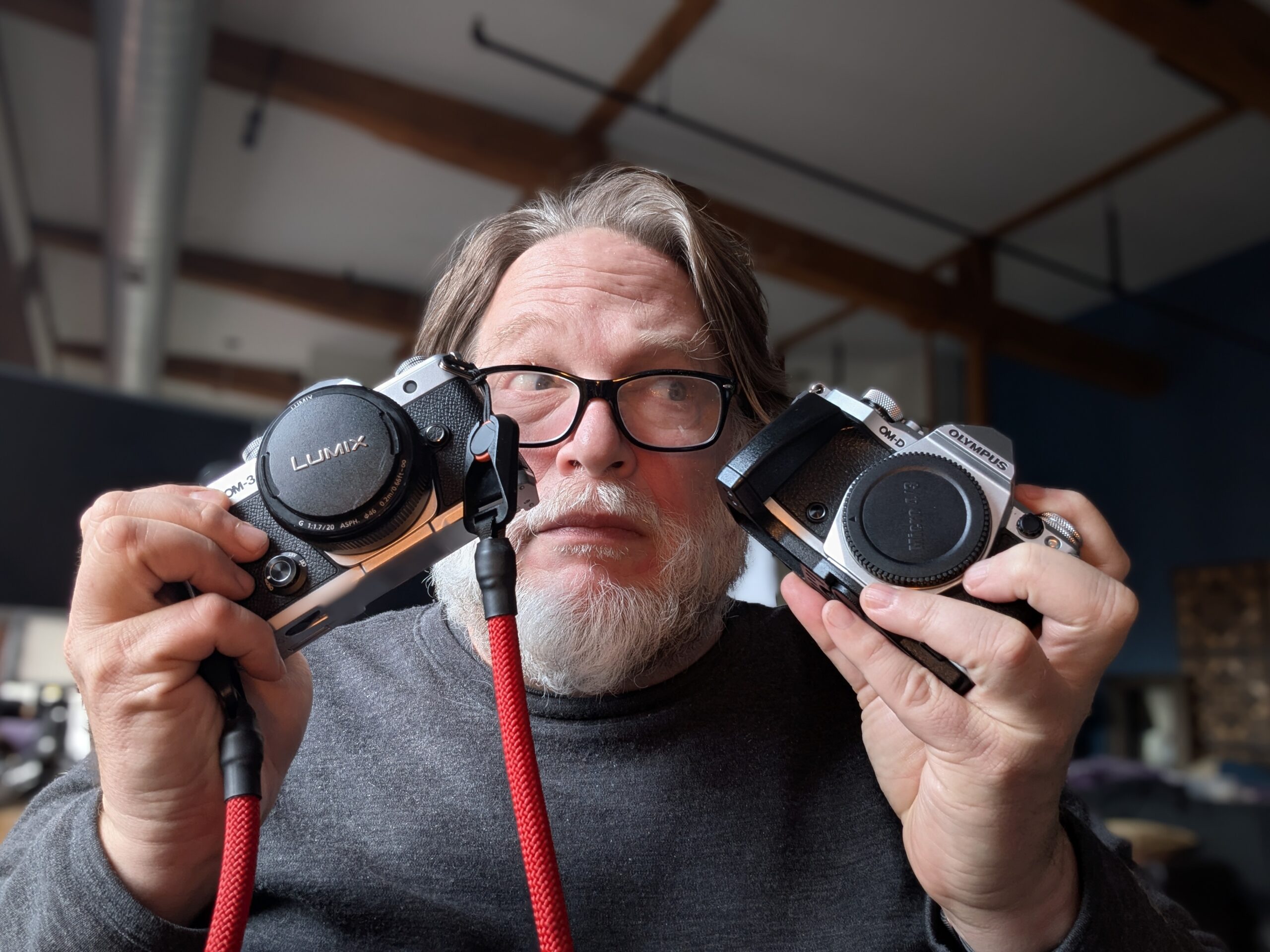
- What size should the gear be? I have a high quality full frame Sony and it’s wonderful, but also a bit big and bulky. The, I purchased the OM System OM-3, and it’s fun and light and I wear it around my neck pretty much every single day.
- What weather will you encounter? Some cameras have gone to war (Nikon, for instance). Others can survive in harsh weather. Some are pretty but won’t survive contact with the lint in your pants pocket without a problem. It’s important to consider this, as well. Some systems have better weather capabilities than others.
Let’s read on and learn a bit more about other decisions along the way.
Camera Type: Point-and-Shoot, DSLR, or Mirrorless?
Let’s start with the broadest question: what kind of camera do you actually want?
Point-and-Shoot Cameras
A point-and-shoot camera is exactly what it sounds like. You frame, you shoot, and the camera handles most of the thinking. They’re small, pocketable, and simple. If you want something to throw in a bag and forget about until you need it, this is the appeal.
The catch: you get what you pay for, especially at the budget end. A $100-200 point-and-shoot typically has a very small sensor (more on that in a moment), which means worse image quality, especially in low light. Most lack manual controls—no adjusting shutter speed or aperture—so you’re locked into the camera’s decisions. You also can’t change lenses, so you’re stuck with whatever focal length came in the box.
Point-and-shoots make sense if you want simplicity above all else and don’t mind the image quality trade-offs. They’re less relevant as a “first real camera” unless you specifically want something disposable or backup.
I should also warn you: TikTok and Instagram have made certain point and shoot cameras super overpriced. The Canon G7X, for instance. The Sony RX100 VII. And when you get up to the APS-C ones like the Fujifilm X100vi or the Ricoh GR III and such, it’s right up there. Oh, and lest we forget: the Leica Q3 is technically a point and shoot (or at least a fixed-lens) camera. Those go for about $6K USD.
Beyond point and shoot are interchangeable lens cameras. These are, as the name suggests, a camera body where you can swap out lenses.
DSLR Cameras
DSLR stands for Digital Single-Lens Reflex. Here’s what that means: when you look through the viewfinder, you’re seeing the actual scene through the camera’s mirror and prism system. When you press the shutter, that mirror flips up to expose the sensor. It’s mechanical, it’s been proven for decades, and it works.
DSLRs are reliable. The used market is massive, and lenses are cheap because millions of these cameras have been sold.
The downside: they’re bulkier than mirrorless cameras because of that mirror mechanism. Battery life is way better than mirrorless most times. And crucially, the DSLR market is aging. Canon and Nikon have largely moved on to mirrorless. This doesn’t mean DSLRs are bad (they’re not) but it means fewer new lens options and a shrinking ecosystem. That said, you can buy what used to be a flagship DSLR camera for $200-300 USD, because it will be over ten years old. (Cameras age quite well, most times, by the way.)
Also, if you intend to shoot video, DSLRs must be researched closely, because very few except a few more recent ones shoot 4K video, let alone have all the other features most people want, like in body image stabilization (IBIS).
Mirrorless Cameras
Mirrorless cameras are exactly that: a camera that no longer requires a mirror and prism to show you what’s going on. When you look through the viewfinder, you’re seeing a digital display of what the sensor will capture. It’s more like looking at the back screen, but through an eyepiece.
On the plus side, a mirrorless camera shows you any exposure adjustments, white balance, depth of field, everything in real time before you shoot. Mirrorless cameras are also typically smaller and lighter than DSLRs, and they autofocus faster and more accurately, especially for video or tracking moving subjects.
The trade-off: they chew through batteries faster. They’re newer, so used options are fewer (though this is changing rapidly). And they’re currently more expensive than comparable DSLRs, both new and used.
For a first “real” camera right now, mirrorless is where the industry is heading. But that doesn’t make it the right choice for everyone.
Sensor Size: It Matters Less Than You Think
The sensor is the part of the camera that captures light. People think bigger sensors generally mean better image quality. There are areas where a full frame sensor might do better, such as in low light and shadows, and more creative control over background blur. Beyond that, this fight over which sensor size is better is somewhat like religion more than commonly agreed upon fact.
You’ll encounter these sizes, from smallest to largest:
Tiny Sensors (most point-and-shoots): These produce acceptable photos in daylight but struggle in anything else. Your smartphone has a better sensor and camera computational power than most inexpensive cameras with tiny sensors.
Micro Four Thirds: A crop sensor standard used by Olympus and Panasonic. Smaller than crop sensors in DSLRs, but still viable. Good if you want small, lightweight gear. They struggle a bit in low light, don’t quite have the depth of field capabilities of larger sensors. But on the plus, they are often quite weather sealed, and the lenses for this system are much smaller (and often more affordable) than their larger brethren.
Crop Sensors (also called APS-C): Used by Canon, Nikon, Sony, Fujifilm, Ricoh, and others. These are a good middle ground. Smaller than full frame, so you get less low-light performance and less background blur, but the difference isn’t dramatic for beginners. Lenses are cheaper. Huge used market. A lot of people choose APS-C as their first real camera.
Full Frame: The “standard” for professional work. (Or so it used to be) Noticeably better low-light performance and background blur control than crop. More expensive, both for the camera and lenses. More than you need to start, maybe, but also a consideration.
Medium Format: Much larger than full frame. Overkill for a first camera unless you’re doing specific professional work. (But kind of neato.)
I started with an APS-C camera, then tried another, another, and eventually got a full frame camera (all mirrorless). I tried out (and loved) a DSLR for a while, but it’s a bit bulky for every day usage (for me). And the funny part: after a year or so with the full frame, I went back and bought a micro four thirds sensor camera and I’m enjoying it a lot. So it really is a matter of choice.
Key Things to Evaluate
Should you buy new or used? Well, I’ve bought 99% of my gear on the used market and have had great success. Some people want new, solely so they know how the camera has been treated. It’s really your call, but many people have expressed success buying used, with some understanding. No matter how you choose, let’s talk through considerations.
Reputable Sources
I need to disclose that I live in the US and some of my advice might not be accurate for your local market. It’s always good to ask local photographers about where they shop. That said, some experience-based information.
- MPB.com – great online resource for purchasing used cameras.
- KEH.com – like MPB. Kind of a preference thing.
- eBay – I’ve had great success on eBay, but you need to know what to look for. (More in this post.)
- B&H Photo and Video – based in New York City. Reputable.
I can’t vouch as much for Facebook Marketplace. It’s a lot more hit or miss. But some people, the kind who don’t mind taking a risk, report they’ve had some big wins there. Others have reported scams.
So, what will help you find your first real camera safely?
Seller Reviews
On eBay for instance, you can see whether the seller has many reviews posted against them. It’s okay if they don’t have 100% approval ratings – can’t please everyone. But it’s important to at least have some level of reputation. If you see zero reviews, it could be a scam or a bot.
Shutter Count (Used Cameras Only)
A camera’s shutter is often mechanical, and one of the parts that can wear down. Like any mechanical part, it wears out. Manufacturers typically rate them for 100,000 to 200,000 actuations, though they often last longer.
When buying used, always ask for the shutter count. You can check it by uploading a photo to websites like Shuttercountapi.com. A camera with 50,000 clicks is better than one with 150,000. Anything under 100,000 is likely good; anything over 200,000 is getting worn but not necessarily done. It’s a bit more risky.
Autofocus System
Certain cameras and systems are more known for good autofocus or otherwise. Different models within a range are sometimes better at autofocus than others. Depending on what you’re hoping to photograph, you might consider how important the quality of autofocus is for your purchasing decisions.
Build and Weather Sealing
It’s important to know that build quality is a matter of choice these days. Some lenses, for instance, are made mostly of plastic and glass, except for the metal contacts. Some cameras feel more plastic and others have metal parts, or at least some alloy. It’s all worth looking at yourself and deciding. But don’t let plastic hold you back.
Weather sealing matters if you’re going to photograph in areas that are more prone to challenging weather. These are electronic devices so without a proper underwater case, it’s not like you want to drop them in a mud puddle. But some cameras fare better in weather than others. Some are officially capable of rough weather environments. Others are partially so.
Lens Ecosystem
Depending on some of your choices above, this will matter not at all, or it will mean everything. A camera is only as good as the lenses available to it. Some systems have a massive array of lenses available to it (Sony stands out). Others have legendary glass. Canon tends not to play well with third parties, so some of their systems lack the amount of lens options as others. Micro four thirds has an alliance that makes it that you can use many lenses across all their platforms.
The best lenses in the world will cost as much as (or more than) your camera. But there are also budget lenses from third party companies like Viltrox, Tamron, Sigma, and more.
I’ll write more about lenses in other posts, but they really are ultimately what matters most to your experience, once you get a decent camera body in place.
Ergonomics
Hold it. Use it. Does the button layout make sense? Can you reach everything comfortably? This is personal. What works for one person feels awkward for another. Don’t skip this.
And somewhat related, are you willing to lug around a big camera, or do you need something tiny? Do you want it to be something you can hold for hours at a time? Or does that matter?
Video Capabilities
If you don’t care about video, skip this. If you do, mirrorless cameras generally perform better, and specs matter more (autofocus during video, frame rates, codec options). Budget DSLRs often have mediocre video.
Remember, too, that if you want ONLY video, you might consider action cameras like the DJI OSMO 3 or the Insta360 Ace Pro 2.
New vs. Used
New: You get a warranty, a fresh battery, and peace of mind. You’re paying a premium for this, but it’s not unreasonable.
Used: You can get significantly better gear for the same money. A used entry-level full frame from five years ago might cost the same as a new entry-level crop camera.
If buying used, check the shutter count, ask about the camera’s history, try to see sample photos, and buy from reputable sellers (KEH, B&H, or local buyers you can inspect the camera with in person). Avoid anything that shows signs of heavy use, internal issues, or is suspiciously cheap.
On that last point: if the price seems crazy lower than others you’ve looked at, don’t do it. There are almost never any good endings to that story.
What Not to Worry About
Don’t obsess over specs like megapixels (24MP is plenty), ISO range, or autofocus point count. These matter less than you’d think. Don’t assume more expensive is better for your needs. Don’t assume you need 4K video or weather sealing (unless you do).
Also, be wary of “scameras.” On sites like Amazon and others, there are often no-name-brand cameras that boast 4K video or 50 megapixels, but cost only a few hundred dollars. They are always always always bad/fake/wrong. Skip them.
The Decision
You’re choosing between simplicity and flexibility, between DSLR for the budget, or mirrorless because it’s future minded, between crop sensors and full frame. There’s no objectively correct answer, only what fits your needs, budget, and the lenses you actually want to use.
What matters most to you? Portability? Image quality? Lens options? Budget? Start there, and the choice usually becomes easier.
And if ever you’re stuck and want consideration, swing by Reddit and go to /r/cameras. Lots of people there will help you decide.
Or email me: chris @ chrisbrogan . com
Leave a Reply