

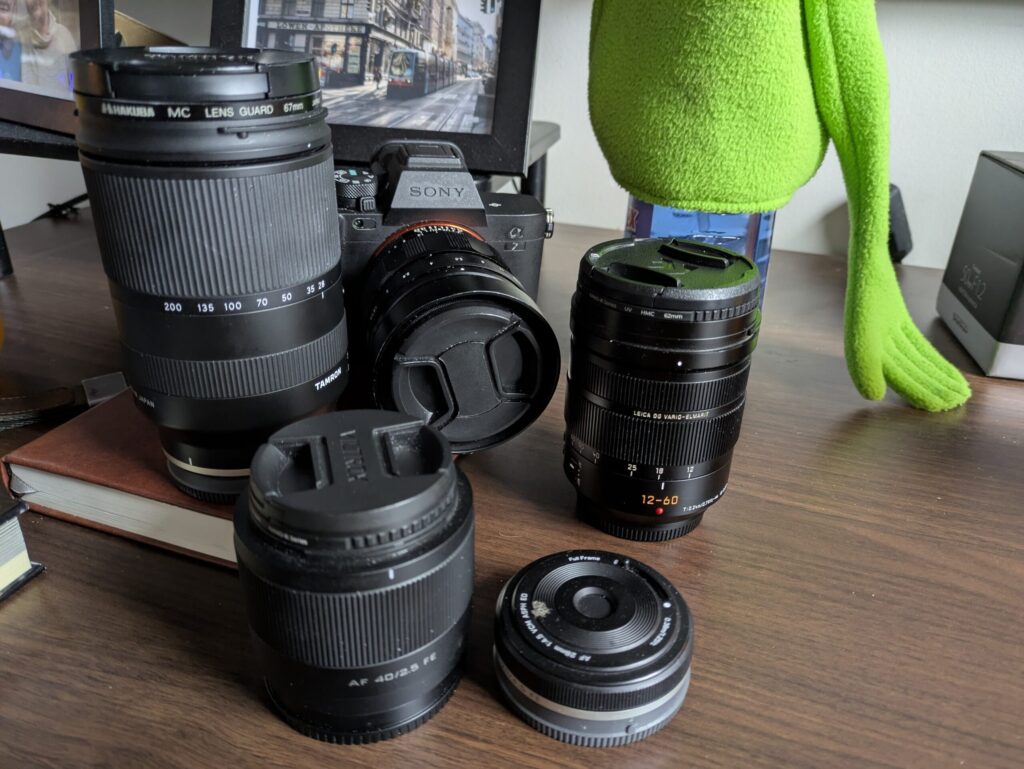
You’ve chosen your first camera. Now comes the next question: which camera lenses do you need?
If the camera body is the box that holds the sensor, the lens is what actually captures the image. It’s where the optical quality lives. And if you’re shopping for lenses, you’ll quickly discover that lens options are overwhelming. There are primes and zooms, fast and slow lenses, different mounts, different brands. The acronyms alone (AF, VR, USM, STM) can make your head spin.
But here’s the good news: lenses follow simple rules. Once you understand what the numbers mean and why certain lenses exist, the choices become clear. You don’t need every lens. You need to understand what you’re looking at and why it matters.
By the way, I made a video about lenses before you get deep into the article here:
What Focal Length Actually Means for Camera Lenses
What I’m about to say is technically true, but no one really thinks a whole lot about it on any given day EXCEPT as a way to talk about the different fields of view you’ll capture with your camera. That said, he’s the description:
Focal length is the starting point. It’s measured in millimeters (mm) and represents a physical property of your lens. Specifically, it’s the optical distance from the center of the lens to your camera’s sensor when the lens is focused at infinity (on something far away).
Here’s what matters for you: you don’t need to remember the technical definition. What you need to know is what focal length does.
What Focal Length Does: Angle of View and Magnification
Focal length controls two things: how much of the scene you capture and how large objects appear in your frame.
A short focal length (like 24mm) captures a wide view. You see a lot of the scene. Objects in the frame appear smaller and further away. This is useful for landscapes or when you’re in a tight space.
A long focal length (like 200mm) captures a narrow view. You see less of the scene but objects appear much larger and closer. This is useful for wildlife or sports where the subject is far away.
Think of it like this: a 24mm lens is like a wide window showing the whole room. A 200mm lens is like looking through binoculars at something across the street.
Shorter focal length = wider view, smaller subjects. Longer focal length = narrower view, larger subjects.
How to Read the Details on Camera Lenses
When you look at a lens, you’ll see something like this: “Canon EF 24-70mm f/2.8L IS USM” or “Nikon AF-S 50mm f/1.8G.”
Let’s break down what these numbers and letters actually mean.
The focal length (the first number or range)
“24-70mm” or “50mm” tells you the focal length or focal length range.
If you see one number like “50mm,” that’s a prime lens. It has a fixed focal length. The lens only works at 50mm. You can’t zoom.
If you see a range like “24-70mm,” that’s a zoom lens. You can adjust the focal length anywhere between 24mm and 70mm by zooming in or out.
The aperture (the f-number)
“f/2.8” or “f/1.8” tells you the maximum aperture of the lens. Aperture is how wide the lens opens to let light in. A smaller f-number means a wider opening and more light. An f/1.8 lens opens wider than an f/2.8 lens, which opens wider than an f/5.6 lens.
For now, remember this: smaller numbers = wider aperture = more light = “faster” lens. (We’ll talk a little later why this doesn’t ALWAYS matter, but why people tend to value lenses based on this stat.)
Why is this on a lens name? Because the maximum aperture is one of the most important specifications. It affects how well the lens works in low light, and it affects depth of field (how much background blur you can create).
Variable aperture zooms
Some zoom lenses show an aperture range like “f/3.5-5.6.” This means the aperture changes as you zoom.
At 18mm (the wide end), the maximum aperture is f/3.5. But as you zoom to 55mm (the long end), the maximum aperture becomes f/5.6. You’re losing light as you zoom in. This is why variable aperture zooms are less expensive than constant aperture zooms (lenses where the aperture stays the same throughout the zoom range).
This matters for low-light photography. If you’re shooting indoors without flash, a zoom lens with f/3.5-5.6 will be slower and more difficult to work with than a constant f/2.8 zoom.
Other letters and numbers
“L,” “G,” “IS,” “USM,” “STM,” “VR” all refer to specific features (build quality, image stabilization, autofocus type). You don’t need to memorize these now. Just know they exist and that different manufacturers use different abbreviations. (If you’re like me, you’ll forget most of them except the ones you care about, and so it’s not like this will be on a test.)
Focal Length Categories for Camera Lenses
Beginners think in categories before they think in specific numbers. Here’s how focal lengths break down:
Ultra wide-angle lenses like fisheye (roughly 9mm-12mm)
Fish eye lenses are what you’re looking at when you see those crazy photos where the world looks like it’s bending. Huge for skateboard photos and videos, for instance. I tend to think of them as a novelty lens, but here’s as good a place as any to say “people tend to favor a focal length and see the world in that length.” There’s rarely a right or wrong answer. You’ll learn it from feel.
Wide-angle lenses (roughly 14-35mm)
Wide-angle lenses capture a broad view. They’re great for landscapes, architecture, and indoor spaces where you can’t move back far enough to see everything.
The trade-off: wide-angle lenses distort the image. Straight lines, especially at the edges, can appear curved. This distortion is less pronounced at 35mm and more pronounced at 14mm.
Standard or “Normal” lenses (roughly 35-70mm)
Standard lenses capture a view closest to what the human eye sees. They have minimal distortion and are flattering for most subjects.
There are two focal lengths of lens that people widely and universally think of as “normal” or “every day” or “closest to human vision.” 35mm and 50mm. A 35mm focal length makes a kind of “environmental view” where you can be versatile enough to get a full scene, but also do a portrait where other elements are brought into the scene. A 50mm is often considered both the most used/most favorite length, but some people also say the most boring. (For the record, I’m a 50mm guy. Am I boring?)
The 50mm prime lens is legendary in this range. It’s often called the “nifty fifty.” Why? It’s affordable, small, lightweight, has a large maximum aperture, and teaches you about composition because you can’t rely on zooming. If you’re buying one prime lens as a beginner, a 50mm is the classic choice. LOTS of people, including some of the world’s best and most famous photographers live on their 50mm ocal length.
Telephoto lenses (roughly 70mm and longer)
Telephoto lenses narrow the view and magnify distant subjects. They’re essential for wildlife, sports, and situations where you want to photograph something far away without getting closer.
Common telephoto focal lengths for beginners are 85mm (great for portraits), 100-200mm (versatile telephoto zoom), and 200-300mm (longer reach for wildlife).
You might also see HUGE zoom lenses for birding and sports. If you’ve ever seen a big huge lens that looks like it’s the size of a traffic cone, that’s a big zoom lens and it’s meant to see smallish things as if they’re standing right in front of you.
Crop Factor and Equivalent Focal Length
Here’s where it gets a bit tricky. But understanding crop factor will save you confusion when shopping for lenses.
Your camera’s sensor might not be full frame. If you have an APS-C camera (crop sensor) or a Micro Four Thirds camera, your sensor is smaller than the “full frame” standard.
This matters because the same physical lens behaves differently on different sensor sizes.
What is crop factor?
Crop factor is a multiplier that tells you what focal length a lens effectively becomes on your specific camera.
Common crop factors are:
- Full frame cameras: 1.0x crop factor (no multiplication)
- APS-C cameras (most Canons, Nikons, Sonys): approximately 1.5x or 1.6x crop factor
- Micro Four Thirds cameras (Olympus, Panasonic): 2.0x crop factor
How to calculate equivalent focal length
Multiply the lens focal length by your camera’s crop factor.
Example 1: You have a Micro Four Thirds camera with a 2.0x crop factor. You own a 20mm lens.
20mm × 2.0 = 40mm equivalent focal length.
That 20mm lens behaves like a 40mm lens on your Micro Four Thirds. On a full frame Sony camera, that same 20mm lens would just be 20mm.
Example 2: You have an APS-C Sony with a 1.5x crop factor. You own a 50mm lens.
50mm × 1.5 = 75mm equivalent focal length.
That 50mm lens behaves more like a 75mm on your Sony. It has a narrower angle of view than it would on a full frame camera.
Why this matters
When you’re shopping for a lens, you need to know what focal length you actually need on your specific camera. If a landscape photographer recommends a 24mm wide-angle lens and you have a Micro Four Thirds camera, that 24mm will feel like 48mm to you. That’s not wide anymore. You might need an 18mm or 12mm lens instead to get the wide-angle view you want.
In my own experience, when I walked around with an APS-C crop camera, I would be looking at a lens and immediately typing the lens focal length x 1.5 to understand what I was looking at. On my micro four thirds camera, it’s easier, because I just double the number. Full frame is full frame.
If you haven’t touched many lenses yet, I know this will all sound like “what?” But it will make sense over time. The first time I bought a 75mm lens for my Fujifilm camera, I felt like I was “up people’s noses” every time I went out to shoot photos of people. That’s because instead of 75, on the body I was using, it was a 112.5mm lens, meaning pretty much a telephoto range. (Not the right tool for the job.)
Prime Camera Lenses vs Zoom Lenses
Now let’s talk about the fundamental choice: should you get a prime lens (fixed focal length) or a zoom lens (variable focal length)?
Both have real advantages. Neither is objectively better. It depends on what you value.
Prime lenses: fixed focal length
A prime lens has one focal length. A 50mm lens is always 50mm. You can’t zoom in or out. If you want a wider or tighter view, you physically move closer or farther from your subject.
Advantages of prime lenses:
- Sharper images. Prime lenses typically have fewer optical elements, so there’s less opportunity for distortion and aberration. The image quality is often superior.
- Larger maximum apertures. Prime lenses commonly come with f/1.8 or f/1.4 apertures. This lets in much more light than most zooms, making them great for low-light photography and creative depth of field control.
- Smaller and lighter. Without zoom mechanics, prime lenses are compact and easy to carry.
- Better image quality in the specifics. Background blur (bokeh) tends to be cleaner and more pleasing with prime lenses.
- More affordable. A 50mm f/1.8 prime is often cheaper than a comparable quality zoom. (Until you start getting into each camera brand’s “premium” versions, but hey.)
Disadvantages of prime lenses:
- Less versatile. You’re stuck at one focal length. If you want a different view, you move your body or buy another lens.
- More thinking required. You can’t adjust the focal length to frame your shot quickly. This teaches composition but can be frustrating at first.
- You might need multiple lenses. If you want both wide and telephoto capability, you need to buy two lenses instead of one zoom.
One quick personal note: on my Sony A7iv, I use a 50mm f1.2 prime lens 90% of the time or more. I just “zoom with my feet.” It works exceptionally for me. On my micro-four-thirds system, I use almost entirely zooms. Because they’re smaller. Because I like experimenting with something different. I have two primes for the M4/3 system too, though. Because for ME (and don’t choose based on my preferences), I like primes more than zooms.
Zoom lenses: variable focal length
A zoom lens covers a range of focal lengths. An 18-55mm zoom can be 18mm, 35mm, 50mm, or anywhere in between.
Advantages of zoom lenses:
- Versatile. One lens covers multiple focal lengths. An 18-55mm zoom replaces what would require three or four prime lenses.
- Convenient. You don’t need to swap lenses or move as much. Just zoom to frame your shot. (This is the most important factor – especially in harsh weather, or areas where you have to work quickly, and can’t afford the time to swap out primes).
- Great for learning. Using a zoom lets you experiment with different focal lengths and discover what you like before investing in multiple prime lenses.
- Good for travel. One lens does everything.
Disadvantages of zoom lenses:
- Smaller maximum apertures. Most affordable zooms max out at f/3.5 or f/5.6. Compare that to a 50mm prime at f/1.8. Low-light photography is harder. Creating shallow depth of field is harder.
- More optical elements means more potential for image quality issues. Zooms are generally softer and have more distortion than comparable prime lenses.
- Larger and heavier. The zoom mechanism adds bulk.
- Variable aperture confusion. As you noted earlier, aperture changes as you zoom. This can make exposure settings unpredictable.
Which should you choose?
If you value simplicity and versatility, start with a zoom. Your camera might have come with a kit zoom lens (usually 18-55mm or equivalent). That’s a perfectly reasonable starting point. But remember that a “kit” lens is often a compromise in either image quality or some other way. They’re good. Just not AMAZING.
If you want to learn focal length quickly and understand composition, start with a prime. The 50mm is the classic beginner prime. It forces you to think about framing instead of relying on the zoom slider.
Over time, consider getting both eventually. Many photographers use a zoom for general purpose shooting and a prime for specific situations (low light, portraits, creative depth of field). Photo journalists, for instance, often pair up a 24-70 zoom, and a 70-200 zoom and call it good. But some take just a 50 and call it great.
Prime Camera Lens Advantages: Image Quality and Sharpness
Let’s dig deeper into why prime lenses are often preferred by serious photographers.
Optical simplicity equals image quality
A prime lens has fewer optical elements (the individual pieces of glass inside the lens). Fewer elements means fewer opportunities for light to scatter, distort, or lose quality. The result is usually a sharper, cleaner image with better contrast.
This isn’t marketing hype. It’s physics. More glass equals more complexity equals more potential for image degradation.
Sharpness across the frame
Prime lenses tend to be sharp across the entire frame, edge to edge. Many zoom lenses, especially affordable zooms, are sharpest in the center and softer at the edges. For general photography this doesn’t matter much. But if you’re printing large or cropping later, edge sharpness matters.
Less distortion
Distortion is when straight lines in reality appear curved in your photo. It’s a side effect of how zoom lenses bend light. Prime lenses, especially in the standard focal length range, have minimal distortion.
Chromatic aberration
This is color fringing, usually visible as red or blue halos around high-contrast edges. It’s more common in zooms because the multiple elements make it harder to control.
Will you notice the difference?
As a beginner, probably not immediately. The difference between a good prime and a good zoom is noticeable when you look closely, but it’s subtle. When you start printing large or comparing 100% crops side by side, the difference becomes obvious.
This is why professionals often prefer primes. In controlled lighting or for critical work, that extra sharpness and image quality matters. For casual photography, a good zoom is perfectly fine.
Understanding Aperture in Camera Lenses: Fast vs Slow
We touched on aperture earlier, but it deserves more detail because it’s one of the most important specifications you’ll encounter.
Fast vs slow lenses
A “fast” lens has a wide maximum aperture (small f-number like f/1.8 or f/2.8). A “slow” lens has a narrower maximum aperture (larger f-number like f/5.6 or f/8).
Fast lenses let in more light. In low-light situations, they let you shoot without flash and without a tripod. Slow lenses require more light or require slower shutter speeds, which can lead to camera shake and blurry photos.
Fast lenses also let you create a shallow depth of field more easily. That blurry background effect in portraits? You need a wide aperture to create it.
Why some lenses are slow
You might wonder why anyone would buy a slow lens. There are practical reasons.
Slow lenses are cheaper. Designing and manufacturing a wide aperture is expensive. The front lens element needs to be larger, and the internal mechanics are more complex.
Slow lenses are lighter. Less glass equals less weight.
Slow lenses are sufficient for daylight shooting. If you mostly photograph outdoors in good light, a slow lens works fine.
You don’t always need the fastest lens
This is important: you don’t need an f/1.8 lens for everything. Here’s when a slower lens is perfectly fine:
Outdoor daylight photography. A slow zoom like f/5.6 works great in sunlight. You have plenty of light.
Landscape photography. You usually want more depth of field (not less), so you stop down the aperture anyway. A slow lens pushes you in the right direction.
Video. Many slower lenses are optimized for video. A slow lens can be great for video work.
Travel photography. If you want to pack light and don’t plan on low-light shooting, a slow zoom is practical.
When you need speed
Indoor photography without flash. Concert photography, theatrical photography, candid indoor events. A fast lens is essential.
Shallow depth of field work. Portraits, product photography, any situation where you want a blurry background. Fast lens = more options for creative blur.
Sports or wildlife in mixed light. If light changes from bright to dim, a fast lens gives you flexibility.
Low-light situations where you want to hand-hold. Fast lenses let you use faster shutter speeds, reducing camera shake.
Aperture behavior across focal lengths
Here’s something that confuses beginners: an f/2.8 aperture is not the same amount of light on a 50mm lens as on a 300mm lens.
This seems counterintuitive, but here’s why: the f-number is a ratio. f/2.8 means the focal length divided by 2.8. So:
50mm lens at f/2.8 = aperture diameter of about 18mm 300mm lens at f/2.8 = aperture diameter of about 107mm
The 300mm lens needs a massive front element to achieve that f/2.8 aperture. This is why fast telephoto lenses are expensive and heavy. A 300mm f/2.8 is a professional-grade lens costing thousands of dollars.
This is also why you don’t see many slow telephotos with ultra-wide apertures. It would be impractical.
Autofocus vs Manual Focus
Most beginners use autofocus lenses. The camera automatically focuses on your subject when you press the shutter button partway down. This is convenient and usually works well.
But you should know manual focus exists and when it matters.
Autofocus advantages
Fast and accurate. Modern autofocus systems lock on instantly and stay focused as your subject moves.
Saves thinking time. Especially for fast action, autofocus lets you concentrate on framing and timing instead of focus adjustments.
Better in most situations. For general photography, autofocus is superior.
Manual focus advantages
Full control. You control exactly where the lens focuses. No autofocus hunting or focus errors.
Better in some situations. Macro photography (extreme close-up), astrophotography (focusing on stars), or through-window shooting where autofocus gets confused.
Older lenses. Many excellent vintage lenses are manual focus only.
Fine-tuning. Sometimes autofocus locks onto the wrong part of a subject. Manual focus lets you adjust. Real world story: my kids and I were snapping pics at a zoo. The animals were behind bars, but also behind nets, and the kids were using only autofocus and their shots often caught the net and not the animal. Because I was using my lens in manual mode, I could tell the lens exactly where I wanted it to focus.
Autofocus speed and accuracy
Not all autofocus systems are equal. Some lenses focus faster than others. Some are more accurate, especially in low light.
When evaluating lenses, autofocus speed can matter. If you’re photographing fast action (sports, wildlife), a lens with quick, accurate autofocus is valuable. This is where reading reviews is important. For instance, lots of people say the Sony 50mm f1.8 has a lot of issues with autofocus. I ignored that feedback, bought the lens, and immediately sold it back after it spent half the time “hunting” for the subject. It’s not a bad lens. It was a bad lens for me.
In low light, some autofocus systems struggle. If you shoot concerts or theatrical events, this matters. Others are specifically designed for low-light focusing.
Most entry-level lenses focus adequately. As you advance and specialize, autofocus performance becomes a meaningful consideration.
Image Stabilization
Image stabilization (also called vibration reduction or optical stabilization depending on the manufacturer) is a feature that reduces blur caused by camera shake.
When you hand-hold a camera and use a slow shutter speed, tiny movements in your hands cause the image to blur. Image stabilization detects this movement and shifts internal lens elements to compensate.
When image stabilization helps
Low-light photography. Slower shutter speeds are required, so stabilization lets you get sharp images without a tripod.
Zoomed in. Longer focal lengths magnify movement more. A 200mm lens makes camera shake more obvious than a 50mm. Stabilization helps.
Hand-holding telephoto lenses. Telephoto zooms with stabilization are much more usable without a tripod.
Video. Stabilization smooths out handheld video work.
When image stabilization doesn’t matter
Bright daylight. You have enough light to use fast shutter speeds. Camera shake is not a concern.
Using a tripod. If the camera is stable, there’s no movement to stabilize.
Prime lenses at wide apertures. If you shoot at f/1.8 in daylight, your shutter speed is very fast. Shake doesn’t happen.
Is image stabilization worth the extra cost?
Image stabilization adds cost and weight. Whether it’s worth it depends on how you shoot.
If you shoot mostly outdoors in good light, skip it. If you shoot indoors, at night, or with telephoto lenses, it’s valuable.
Many modern lenses have stabilization built in. It’s becoming standard, so the cost premium is smaller than it used to be.
Lens Mounts and Compatibility
This is critical: you cannot just buy any lens and attach it to any camera. Lenses only fit cameras with matching mounts.
A lens mount is the mechanical connection between lens and camera body. Each manufacturer uses a proprietary mount. Canon uses Canon RF or EF mounts. Nikon uses Nikon Z or F mounts. Sony uses Sony E mounts. Olympus uses Micro Four Thirds mounts.
A Canon lens will not attach to a Nikon camera (without an adapter). Forcing it will damage both.
Checking compatibility
When you’re shopping for a lens, look at the mount specification. It will say something like “Canon RF” or “Nikon Z” or “Sony E.”
Match it to your camera’s mount. Your camera manual or camera’s product page will tell you what mount it uses.
What about adapters?
You’ve probably heard about lens adapters that let you use old lenses on new cameras or lenses from one brand on another brand’s camera.
Adapters exist, and some work reasonably well. But here’s the reality: adapters are compromises.
When you adapt a lens to a different mount, you lose autofocus capability usually. Sometimes you lose autofocus and exposure control. Manual focus older glass can work fine with an adapter, but modern lenses often don’t function well adapted.
Additionally, adapting changes the effective focal length of a lens (crop factor again). You’re adding mechanical complexity and optical layers.
The advice: buy lenses designed for your camera’s mount. Adapters are for specialty use (like reviving old glass you already own), not for general lens shopping.
Third-party manufacturers
Sony and Nikon have the largest lens ecosystems, but they’re not the only game. Sigma and Tamron make excellent lenses that fit Canon, Nikon, and Sony mounts. Fuji has a decent selection of lenses. Of all the companies, I most often hear people say Canon is behind in having enough third party lenses.
I like Viltrox, TTArtisan, 7Artisans, Pergear, and many other 3rd party brands. They’re inexpensive, but also quickly improving their image quality to rival lenses that cost two or three times as much.
These third-party lenses are often cheaper than brand-name equivalents while offering competitive image quality. As a beginner, a Sigma or Tamron or Viltrox lens might be a great value option.
Each manufacturer makes lenses for the major mounts. Check that the lens is available in your camera’s mount before you buy.
Build Quality and Weather Sealing
Beyond focal length and aperture, lenses differ in how they’re built.
Materials
Expensive lenses often use metal barrels and metal mounts. Budget lenses use plastic. Is this a big deal? For casual shooting, no. For professional use or if you’re rough with gear, yes.
Plastic is lighter and cheaper. Metal is more durable and feels better in hand. This is a personal preference and budget decision. You’ll often hear a YouTube lens reviewer talk about “plastic fantastic.” It’s kind of a tease at the build quality, but almost everyone I know uses some plastic bodied lenses.
Weather sealing
Weather-sealed lenses have rubber gaskets around buttons and connections. This protects the lens from dust and moisture.
Is weather sealing essential? No, especially for a beginner. But if you shoot in wet conditions often, or if you’re hiking in dusty environments, weather-sealed lenses are more durable.
Weight and size
Prime lenses are lighter than zooms. Wider apertures require larger front elements, making them heavier. This matters if you’re carrying the lens for hours or traveling with it.
The best lens is one you’ll actually use. If a lens is so heavy you don’t want to carry it, it’s not practical.
Kit Lenses: What They Are and Why They Matter
A lot of cameras come bundled with a lens. Usually an 18-55mm zoom or similar. This is called a kit lens.
Kit lenses are budget-friendly. Manufacturers include them to keep the camera body price down. The quality is basic but functional.
Should you keep your kit lens?
Yes, for now. A kit lens is great for learning. You can experiment with different focal lengths and discover what you like before investing in expensive glass.
Kit lenses have some real limitations. They’re slow (usually f/3.5-5.6), so low-light photography is harder. The image quality is softer than better lenses. But these limitations are learning opportunities. You’ll understand what you want in a lens by exploring what the kit lens can’t do.
Many photographers eventually upgrade from their kit lens, but that doesn’t mean it’s bad. It means they’ve learned their needs.
When to upgrade
You might upgrade when you:
- Realize you need faster glass for low-light work
- Want more telephoto reach
- Discover that the soft image quality bothers you
- Develop a specific photography interest (portraits, wildlife, etc.) that requires different focal lengths
You don’t need to upgrade immediately. Learn with what you have, and upgrade when you have a specific reason.
Macro Lenses and Special Purpose Lenses
Most beginner lenses are “standard” lenses designed for general photography. But specialty lenses exist for specific purposes.
Macro lenses
Macro lenses focus very close to the subject, letting you photograph tiny things (insects, flowers, small products) at life-size magnification or larger.
Do you need one immediately? Probably not. But if you find yourself wanting to photograph small subjects, macro lenses are worth exploring.
Many standard lenses can focus relatively close. They’re not true macro, but they work for casual close-up photography.
Teleconverters
Teleconverters (also called extenders) are small optical accessories that multiply the focal length of a lens. A 2x teleconverter turns a 200mm lens into a 400mm.
The trade-off: you lose about one stop of light with a 2x converter. A 200mm f/4 lens becomes 400mm f/8.
Teleconverters are cheaper than buying a longer telephoto lens but provide less image quality. Useful for specific situations but not essential for beginners.
Constant Aperture vs Variable Aperture Zooms
We touched on this earlier but let’s be specific.
Constant aperture zooms
A 24-70mm f/2.8 zoom has the same f/2.8 aperture throughout the zoom range. From 24mm to 70mm, you have consistent light gathering and consistent ability to create depth of field.
The benefit: predictability. Your exposure settings don’t change as you zoom.
The cost: these lenses are expensive and heavy. A good constant aperture zoom is a serious investment.
Variable aperture zooms
An 18-55mm f/3.5-5.6 zoom has changing aperture as you zoom. At 18mm, f/3.5 is available. At 55mm, f/5.6 is the max.
The benefit: much cheaper and lighter than constant aperture zooms.
The cost: less light, especially at the telephoto end. Your exposure settings need adjustment as you zoom.
For beginners, variable aperture zooms are fine. You have less light, but you’ll learn to work within that limitation. As you advance and specialize, constant aperture zooms become more relevant.
Which Lens Should You Buy First?
Let’s be practical. If you already have a kit lens, you don’t need to buy another lens immediately.
But if you’re buying your first additional lens, here are the most common paths:
Path 1: Stay versatile
Buy a standard zoom like a 24-70mm or even one of those “all in one” lenses, like a 28-200mm (specific focal lengths depend on your sensor size and crop factor). This covers a wide range of situations and keeps you flexible.
Cost: mid-range. Image quality: good but not outstanding.
Best for: people who want flexibility and don’t know their specific interests yet.
Path 2: Learn focal length quickly
Buy a 50mm f/1.8 prime lens. It’s affordable, fast enough for low-light work, and teaches you about composition.
Cost: inexpensive. Image quality: excellent.
Best for: people who want to understand photography basics and don’t mind a fixed focal length.
Path 3: Specialize early
You know you want to photograph portraits? Buy an 85mm f/1.8. Landscapes? Buy a 16-35mm wide-angle zoom. Sports? Buy a 70-200mm telephoto zoom.
Cost: varies. Image quality: depends on the specific lens.
Best for: people with a clear interest who want a lens optimized for that purpose.
The Bigger Picture
A lens is a long-term investment. Good glass holds its value. You might use the same lens for years or even decades.
This is different from camera bodies, which become obsolete. But a sharp 50mm from 20 years ago is still a sharp 50mm today.
Think about what you actually want to photograph. Start there. Choose a lens that serves that purpose. As your interests expand or deepen, add lenses to your kit. You don’t need everything immediately. Build thoughtfully.
And remember: the lens is important, but the person behind it matters more. A beginner with a basic lens and good technique will outshoot a beginner with expensive glass and no technique. Learn to use what you have. Upgrade when you understand why you need to upgrade.
Leave a Reply